
Why Is My Child So Soft-Spoken? How Speech Therapy Can Help
https://www.triumphtherapeutics.com/wp-content/uploads/2025/12/Why-Is-My-Child-So-Soft-Spoken-How-Speech-Therapy-Can-Help-Triumph-Therapeutics-Pediatric-Therapy-Clinic-Washington-DC-Dec01-01-2025.jpg 710 379 Triumph Therapeutics Triumph Therapeutics https://www.triumphtherapeutics.com/wp-content/uploads/2025/12/Why-Is-My-Child-So-Soft-Spoken-How-Speech-Therapy-Can-Help-Triumph-Therapeutics-Pediatric-Therapy-Clinic-Washington-DC-Dec01-01-2025.jpg
Think back to the last time you were in a social setting with people you didn’t know very well.
Who stands out in your memory?
The quiet person who mostly stayed on the sidelines?
Or the loud, energetic person who seemed to dominate the conversation?
Most of us tend to remember the louder voice, even if it wasn’t always the most pleasant.
While these are two extremes, they highlight something important: being heard plays a big role in how we connect with others.
For children with a weak or quiet voice, social situations can feel especially challenging.
Your child may want to speak up but hesitate because others talk over them, or they may feel that what they have to say isn’t important enough to share.
Over time, this can affect confidence, participation, and even how your child sees themselves.
The good news is that a weak voice often has an underlying cause and in many cases, it’s something that can be addressed with the right support.
At Triumph Therapeutics, our pediatric clinic helps children with a wide range of speech and voice challenges, including reduced vocal strength.
In this article, we’ll take a closer look at what causes a weak voice in children, how it can impact daily life, and how pediatric speech therapy can help your child speak more clearly, confidently, and comfortably.
How Can Having A Weak Voice Affect Your Life?
If your child’s voice is weak and quiet, you may just assume they’re a little shy.
But when others perceive your child as soft spoken, it can affect their life in ways you may not realize.
Speaking too quietly, too quickly, or mumbling can make it more difficult for others to understand your child.
This can lead to your child being passed over in social situations.
And if you’re in a loud environment like a bar or restaurant, your child might not be able to be heard at all.
In the long term, your child may get frustrated by not being heard, or being constantly asked to repeat what they said.
Plus, if your child is already shy or anxious, they may stop trying to socialize at all in some situations.
No matter the reason, if your child is speaking with a weak voice, it’s likely having impacts on their life.
What Causes A Weak Voice?
There are several reasons your child might have a weak or quieter than normal voice.
It could be due to medical and physical issues, or social and psychological factors.
If your child has a weak voice, consider if any of the following factors could be responsible.
Medical or physical reasons for weak voice could include:
- Nodules on your vocal cords
- Cerebral palsy
- Throat cancer
- Weak vocal cords (sometimes due to lack of use)
- Dysphonia (hoarse, raspy, or strained voice)
- A respiratory condition
- Vocal cord tension or strain
- Autism
- Juvenile Parkinsonism (very rare)
Some social and psychological reasons for a weak voice may be:
- Lack of confidence
- Feeling anxious or nervous
- Self-consciousness over some aspect of their voice, such as a lisp, a stutter, or accent
- Not wanting to draw attention to oneself
- Shyness
- Depression
- Familial factors – coming from an environment where others speak quietly
- Selective mutism
Parenting Tips For Strengthening Your Child’s Voice
If your child has a weak voice, there are some things you can do to help them find their volume.
These tips can help kids whose weak voice has a social or psychological reason.
However, if your child has an underlying physical limitation, they may be less helpful.
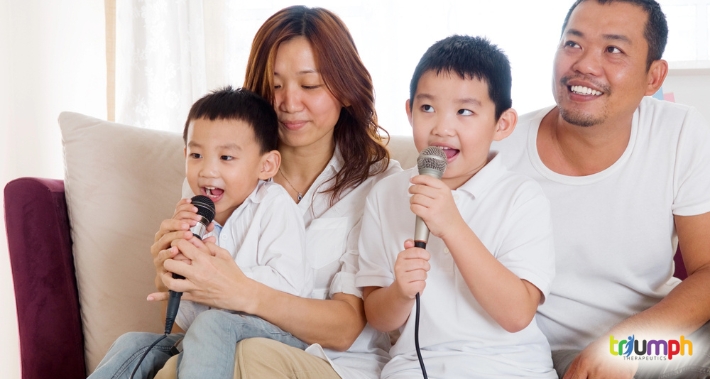
1. Encourage Your Child To Play With Their Voice
Have you ever stood in front of the mirror (or in the shower) practicing a speech, or how you would respond to interview questions?
You can teach your child to do this to work on strengthening their voice as well.
You can encourage them to sing a song they like, or read a story out loud.
As they do, you can encourage them to moderate the volume and pitch of their voice.
You can even encourage them to make different voices for different characters in a story, if they’re able.
2. Teach Them To Speak From Their Diaphragm
The diaphragm is a dome shaped muscle located underneath your lungs.
It contracts as you breathe, and can be used to help project your voice when you speak.
Your child will know if they’re speaking from their diaphragm because their stomach will move as they speak and breathe.
As well, they’ll be speaking louder and more clearly.
3. Modify Their Pitch
You might notice that sometimes when trying to speak more loudly, the pitch of your voice goes higher as well.
It’s also common to speak in a higher pitch during stressful times.
Unfortunately, whether warranted or not, a high pitched voice may be perceived as annoying or shrill.
Sometimes, those with lower voices are taken more seriously.
The former entrepreneur and fraudster Elizabeth Holmes famously lowered her voice in order to be taken more seriously by those around her.
Help your child to practice lowering their pitch when they speak, and try to be aware of when their pitch unconsciously starts to rise.
4. Slow Down Their Speech
In some situations, your child’s instinct may be to speak quickly.
Maybe they’re worried about saying what’s on their mind before they’re interrupted, or maybe it’s just habitual.
Unfortunately, people tend to listen less when others are speaking too quickly.
If your child has a weak voice and they speak quickly, it can make them even difficult to understand.
While speaking too slowly can make someone sound tired and bored, there is a happy medium.
Modeling a slower pace of speech for your child can help them learn what’s more effective.

How A Speech Therapist Can Help Treat Kids With A Weak Voice
If your child has a weak voice, a pediatric speech therapist can help.
The goal of speech therapy for a weak voice is to improve your vocal quality, as well as forming strategies to manage it.
It all starts with an evaluation of your child’s voice.
Your speech therapist will examine your child’s vocal abilities, looking for a potential underlying cause for their vocal weakness.
They’ll also speak to you about your specific concerns.
From there, your pediatric speech therapist will put together a treatment plan designed to address your child’s unique needs.
The goal is to help your child learn to communicate clearly, and with confidence.
Book Your Appointment With Our Pediatric Clinic Today
If your child is consistently soft spoken or struggling to be heard, it may be more than just shyness — it could be a sign of an underlying issue affecting their voice.
Whether the cause is physical, psychological, or a combination of both, early support from a pediatric speech therapist can make a lasting difference.
With the right tools and guidance, your child can learn to speak clearly, confidently, and be heard in any environment.
At Triumph Therapeutics, we’re here to help your child strengthen their voice and express themselves fully.
Book your appointment with our Washington, DC pediatric therapy clinic today and take the first step toward helping your child find their voice.